a Vibrational Model of Development
The following is a blueprint that articulates a rought sketch of a vibrational model of the development, in the spirit of other models such as Integral Theory, but one that attemps to give equal emphasis to both consciousness/perspective and vibration/form.
Introduction: The ‘Problem’ with the Number Line

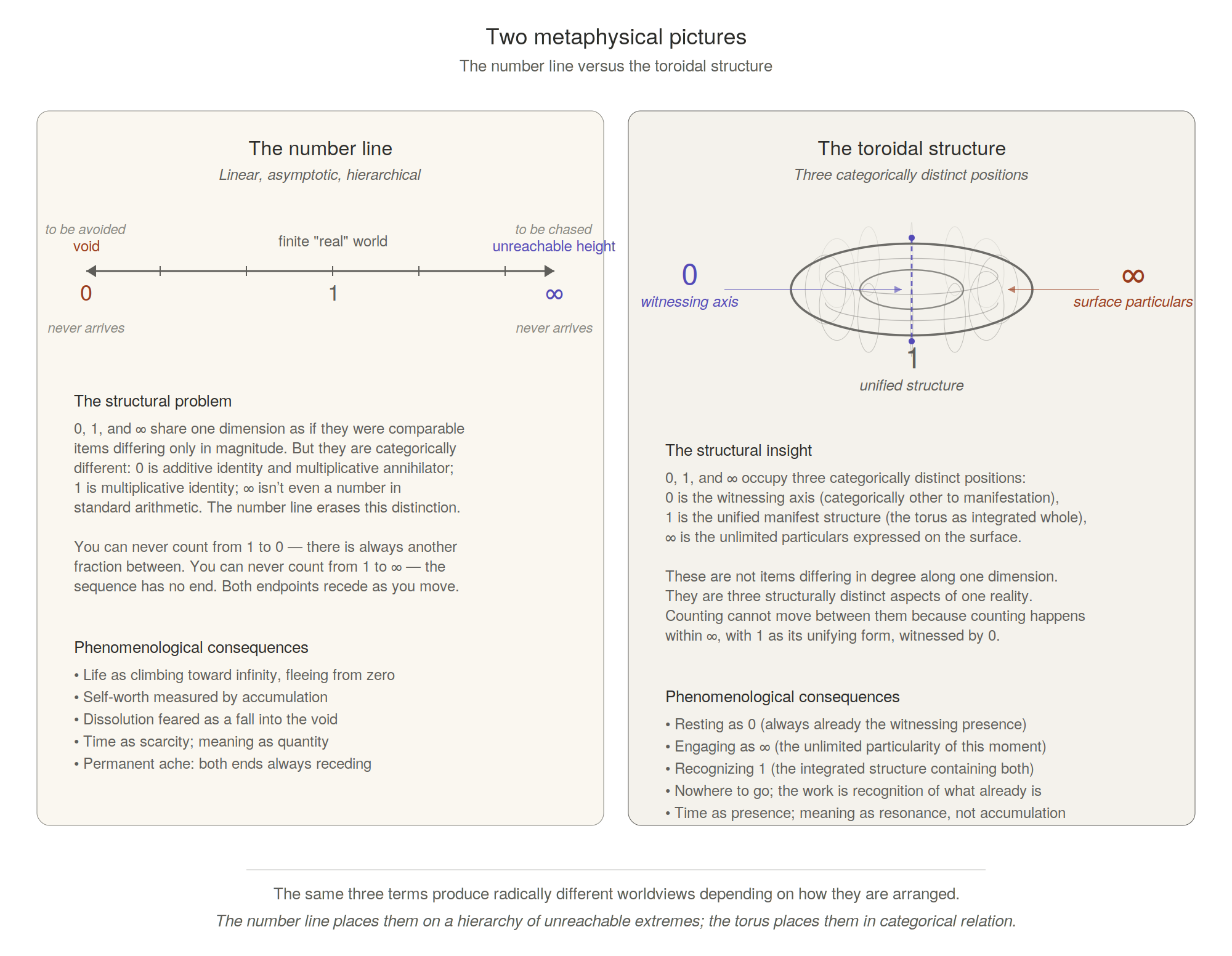
The traditional number line posits zero and infinity on the same trajectory as real numbers. This places zero, finite numbers, and infinity along a single dimension, differing only in magnitude — implying you can move from one to the other by counting, with zero at one end of the line and infinity at the other. However, when counting upward one never reaches infinity, and counting downward one never reaches zero.

Once the number line is internalized as an implicit cosmology, it produces a specific shape to our lived orientation.
Infinity becomes the direction of more — more achievement, more accumulation, more knowledge, more becoming — and zero becomes the direction of less — death, dissolution, the void. Self-worth is determined by one's position along the line, with the basic existential gesture being that of endless accumulation and seeking toward fullness (infinity), coupled with a constant flight from fear of death and dissolution (zero).
The fundamental problem is that this model misrepresents what zero, one, and infinity actually are.
Zero is the additive identity and the multiplicative annihilator — it is the ground in which arithmetic happens, not a quantity within it. One is the multiplicative identity — unified form, the first distinction. Infinity isn't a number at all in the standard sense; it is a limit notion that breaks ordinary operations. These three do categorically different work, and putting them on a single line erases these distinctions.
The recognizable suffering that follows — chronic striving, fear of illness and death, time experienced as scarcity, the exploitation of people and natural resources for material gain, the permanent suffering of horizons that recede no matter how far one travels — the number line is a mathematical metaphor for the condition that spiritual traditions classically define as suffering.
Circle as Antitode
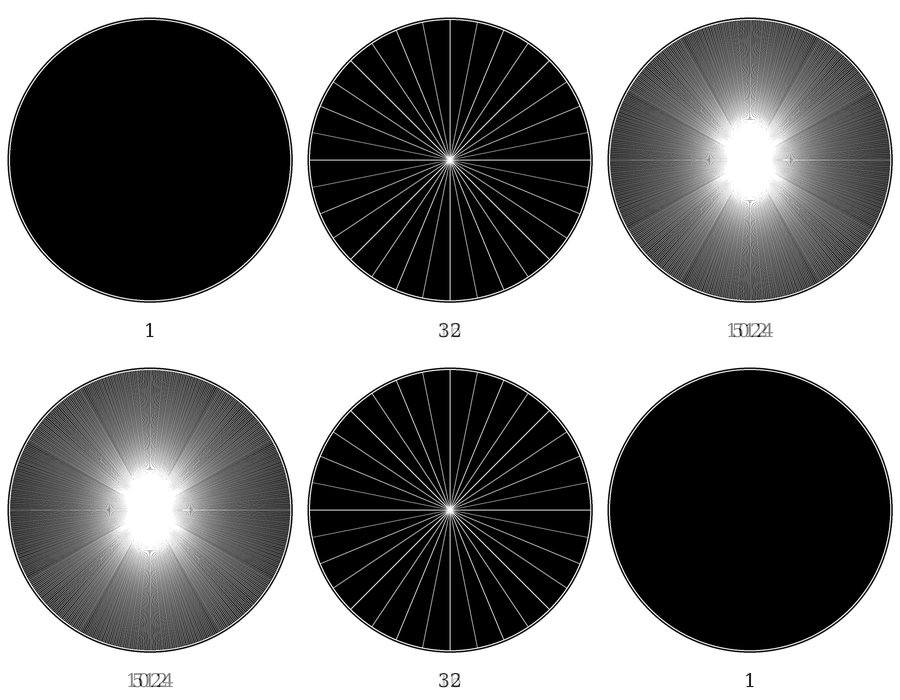
A circular arrangement depicts the same three, yet in their actual structural relations.
Zero is not a number, it is the ground within which numbers arise— it represents consciousness, the witnessing presence in which everything appears (here represented by the black background of the circle).
The circle in its undivided state represents 1, the unmanifest Causal Ground.
Infinity is not at the far end of a road, but is the manifestation of differentiation within the circle, the unlimited specificity of the present moment—you can ‘slice the pie’ into countless gradations, yet it will always be the same pie.
The shift this produces in lived orientation is the substance of the critique. Zero is not something to flee — it is something to rest in and as, ever-present as the awareness reading these very words right now.
Infinity is not something to pursue through accumulation — it is always-already present as the endless differentiated specificity of what is arising.
The work of a life is not a flight from annihilation, or endless seeking and accumulation toward an ever-receding horizon.
The work of life is the ever-greater refinement, allowance and embrace of what is always-already before us, in all of it’s naturally apparent shapes and cycles.
Polarity (+) (-)
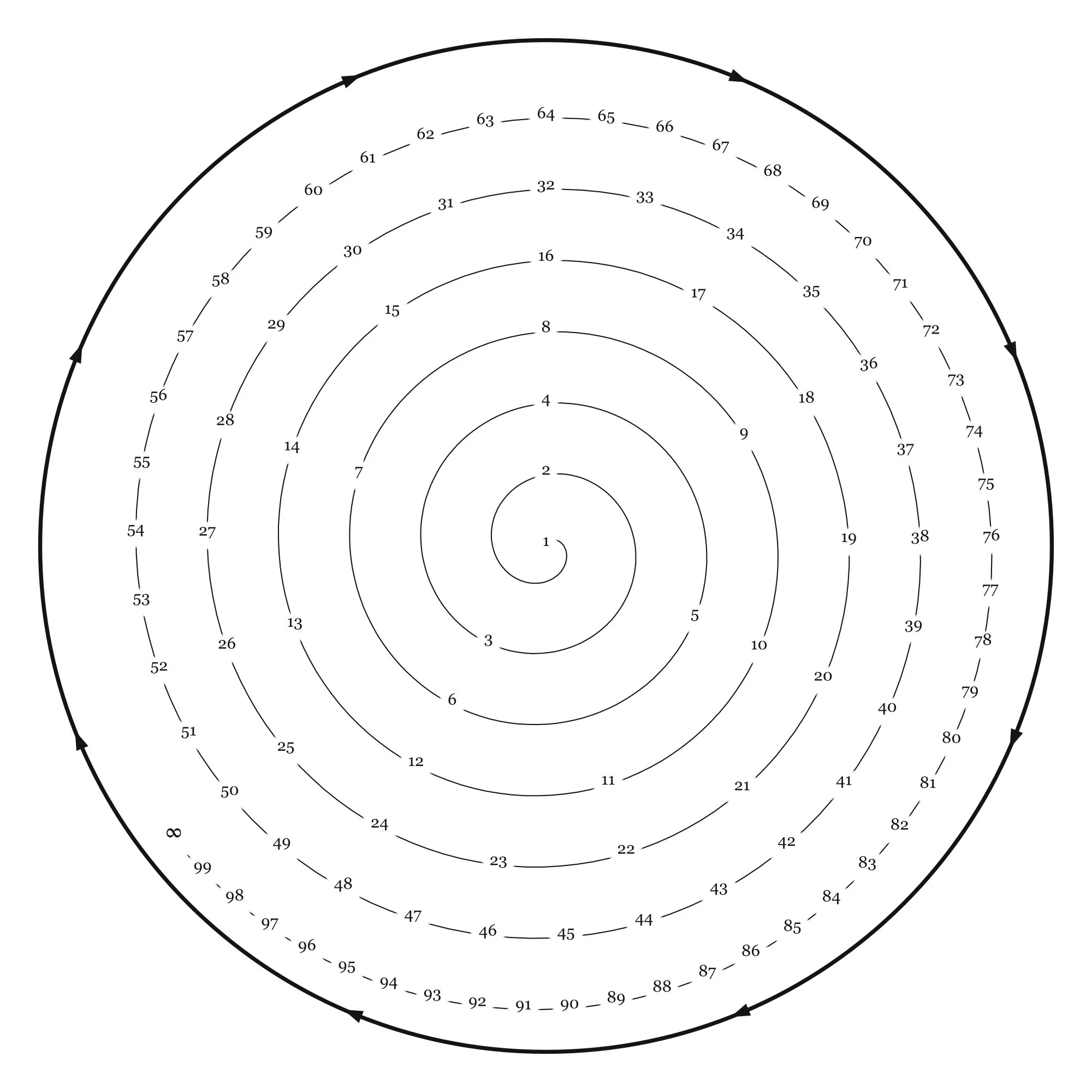
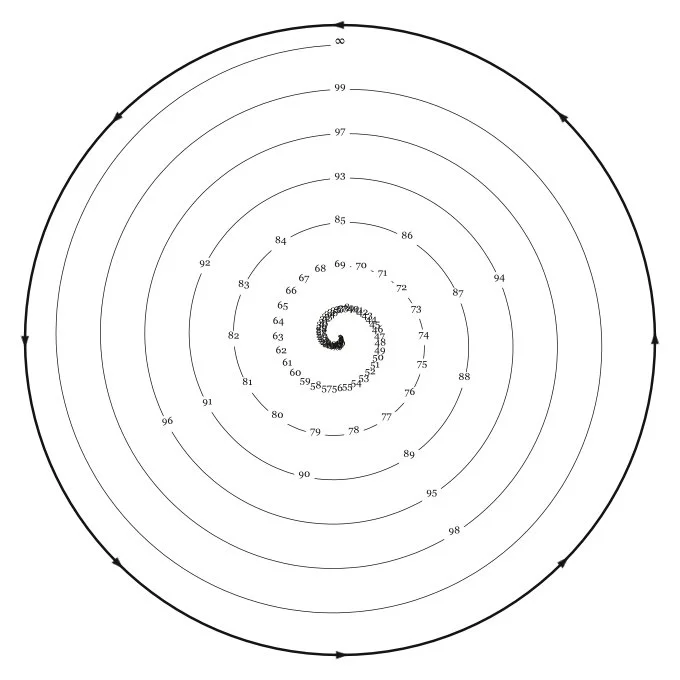
Spiraling outward toward the many (+).
Spiraling inward toward One (-).
The two classical directions—reception and release, involution and evolution, the unfolding of One into many, the folding of many into One.
Time and Space
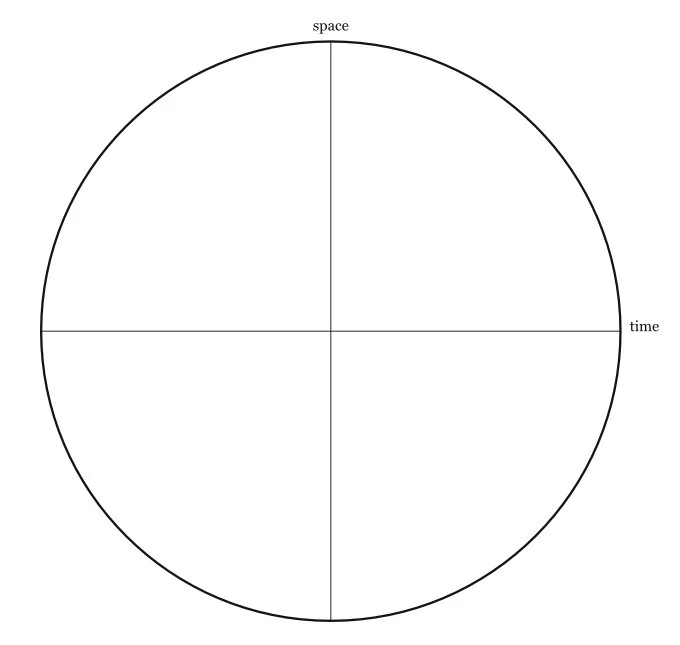
The vertical dimension of space, the horizontal dimension of time.
Spatial States
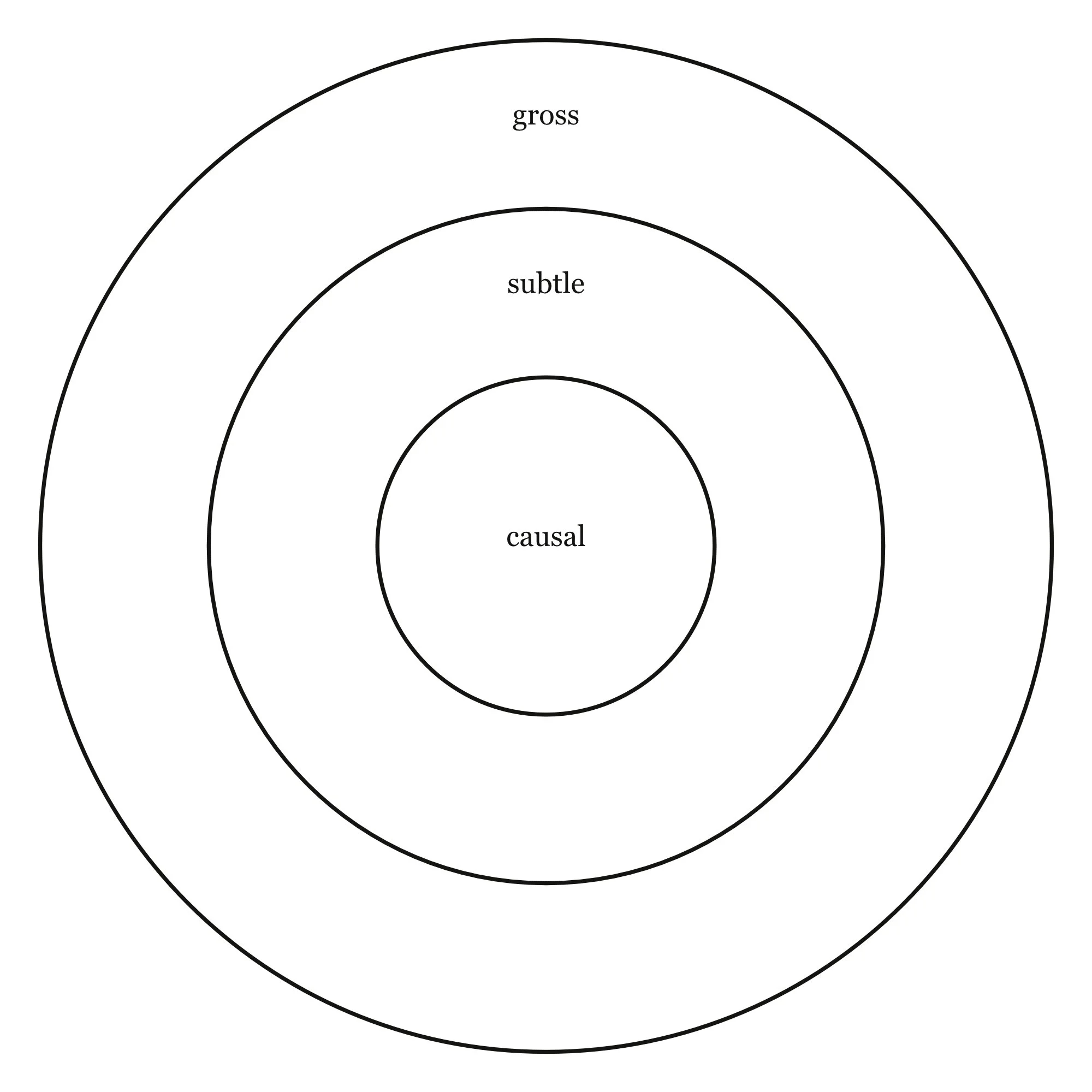
Gross. Waking
Subtle. Dreaming
Causal. Deep Sleep
Temporal Phases
Arising. Emerging from Oneness as apparent form. The striking of the match.
Sustaining. Stabilization of apparent form. The burning of the flame.
Dissolving. Return of apparent form to Oneness, The smoke of the extinguished flame.
Roots and Textures
Four root perceptions/wave forms arising within the field of Radiant Presence.
Each wave form is a specific articulation of texture, quality and root perception.
At the gross level, wave forms manifest temporally as physical vibration, spatially as carrying specific structural geometry.
At the subtle level, wave forms manifest as positions that consciousness can assume, that both influence and are influenced by what is perceived.
At the causal dimension, wave forms exist as pure capacities of root perception.
Each wave form is articulated below with its visual and audio example, accompanied by various descriptors.
Square (Earth)
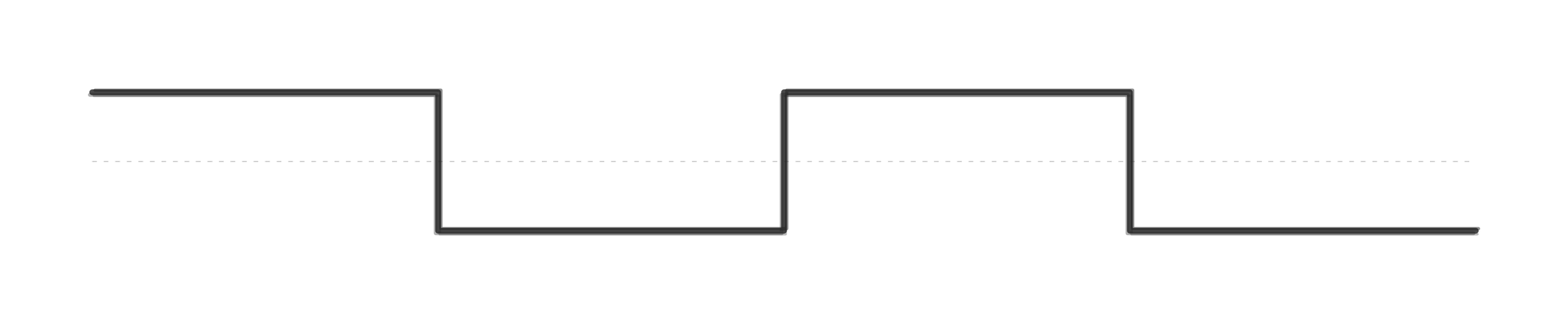
Root Quality: Registration (-) Recognition of distinct phenomena in their categorical definiteness.
Geometry: stepped rectangular alternation.
Traits: vibrating between presence and absence, each moment arriving as a definite event with no blurring between.
Sharp, abrupt, definite, decisive, clear, hard, brittle, exact, flat, matte, blunt, certain, binary, marked.
Temporal: tick, pulse, beat, knock, footstep, click, snap, moment, instant, the strike of a bell, the heartbeat, the metronome, the staccato note, the gunshot, the door slamming, the light coming on, the gavel, before/after, then/now, the threshold-crossing, the discrete event, the punctual.
Spatial: Corner, edge, threshold, boundary, doorway, frame, brick, cell, wall, the hard line, the right angle, the cube, the post, the punctuation mark, the cut, the silhouette, the stamp, the seal, foreground/background, here/not-here, this/not-this.
Gross: tactile, visual, proprioceptive registration of definite individuated objects in space.
Subtle: categorical thinking, formal reasoning, abstract registration of conceptual distinctions.
Causal: registration as pure capacity of awareness, "I sense," beneath any specific registration.
Psychophysical Analysis
alerting, orienting, sharpening attention
The square wave's instantaneous transitions between two values produce what acoustically we hear as a hollow, hard, buzzing tone. Because the nervous system is built to detect changes — sudden onsets, abrupt edges — the square wave's discontinuous jumps trigger orienting responses: a brief sharpening of attention, mild sympathetic activation, the alertness that comes with novelty. Acoustically, the square's odd-harmonic spectrum gives it a quality that the auditory cortex parses as informative — content-bearing rather than ambient. In the body, square-wave sensory inputs (sharp clicks, hard percussive sounds, abrupt visual flashes) activate the salience network and produce small phasic dopamine pulses — the "what is that" reflex. Sustained exposure to square-wave-rich environments (machinery, alarms, hard-edged digital sounds) can produce mild fight-or-flight elevation: heart rate up, muscle tone up, attention narrowed and tasked. This is the wave of categorical recognition taking somatic form: the nervous system marks and indexes, and the excessive result of that marking is a low-grade vigilance.
Sine (Water)
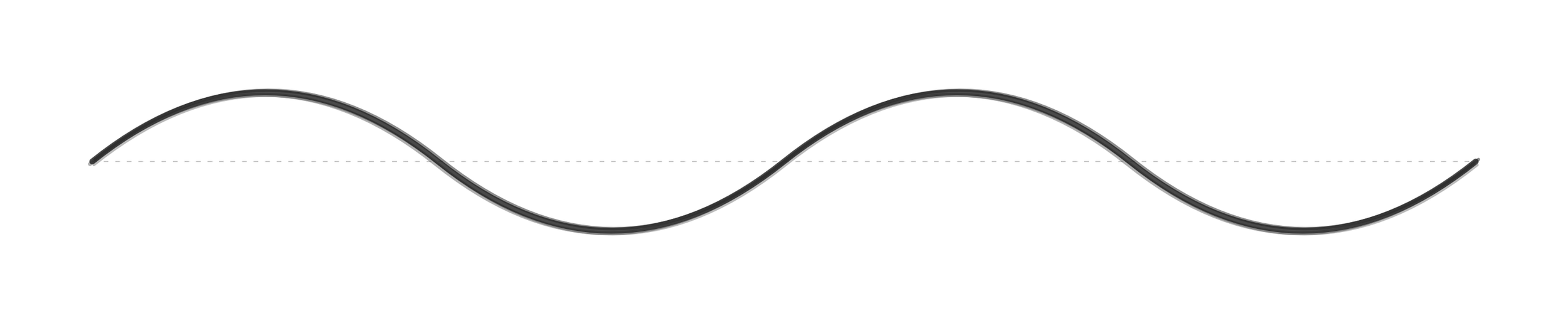
Root Quality: Resonance (-) Receptive attunement to continuous flowing and felt atmospheres.
Geometry: the smoothest periodic curve, infinitely differentiable everywhere with no corners or discontinuities.
Traits: continuous oscillation, the wave that touches everything without breaking.
Smooth, soft, fluid, plush, supple, melodic, lyrical, atmospheric, ambient, viscous, liquid, rolling, soothing, sympathetic, mood-as-mood, weather-as-weather, the felt without the said.
Temporal: breath, tide, pulse-as-flow (not as click), heartbeat-as-rhythm, swell, lull, sigh, hum, drone, sustain, the long note, the held tone, seasons, sleep cycles, the slow turn of the day, the held vowel, the rocking, the lullaby, the rise and fall, the cycle without edge .
Spatial: curve, arc, sphere, ellipse, undulation, ripple, rolling hill, dune, swell, drape, fold, meander, river-bend, breath-shape, the lung, the bay, the cradle, the embrace, the nest, the womb, atmosphere, weather, ocean, the medium, the field, the hum that fills the room.
Gross: embodied attunement with caregiver and environment, responsive coupling before self/other split.
Subtle: felt belonging in shared meaning, attunement with community and culture.
Causal: resonance as pure capacity of awareness, "I feel," prior to any specific feeling.
Psychophysical Analysis
soothing, entraining, dissolving boundary
The pure sine wave, with its single frequency component and no harmonics at all, is acoustically the smoothest possible tone — what we hear as flute-like, hum-like, bell-like at its purest. The nervous system processes sines with minimal effort because there is nothing edge-like to extract. This produces a measurably parasympathetic response: heart rate variability increases, breathing slows and deepens, cortical activity tends toward alpha and theta bands, the default-mode network softens. Sustained sine-wave exposure (singing bowls, drone music, low hums, vocal toning) is the basis of most contemplative-sound traditions because the wave entrains physiological rhythms toward coherence — the body's own oscillations (heart, breath, brainwaves) tend to phase-lock with the external sine, producing a felt sense of being held, attuned, or carried. Sines also dissolve the figure/ground distinction that the nervous system normally maintains; with no edges to attend to, the boundary between listener and sound loosens, which is the somatic correlate of the resonance the wave names. The nervous-system signature of sine is down-regulation, entrainment, and felt continuity — the relaxation response with a quality of merging.
Sawtooth (Fire)
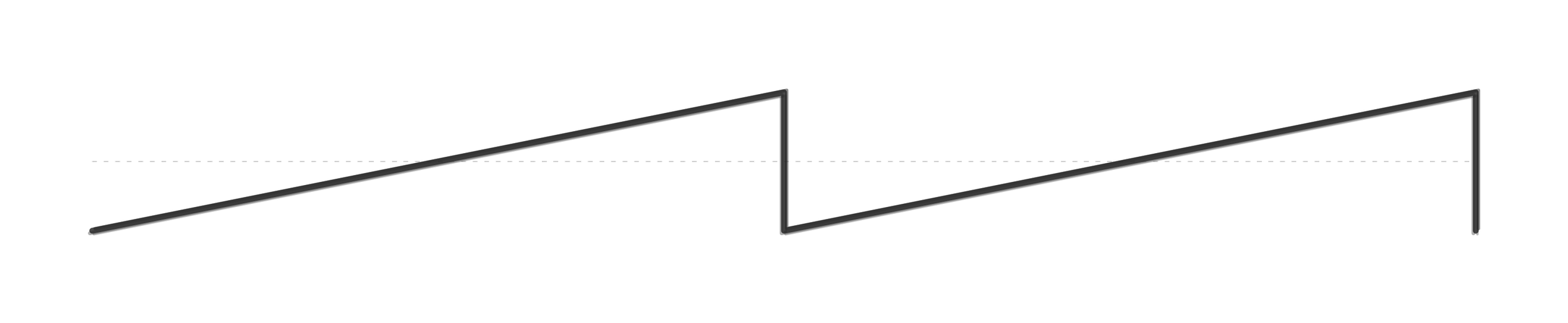
Root Quality: Emergence (+) Directional emergence, asymmetric thrust, individuation as agentic expression.
Geometry: A linear ramp build-up followed by an instantaneous reset/release, asymmetric in time.
Traits: driving, willful, urgent, ambitious, agentic, individuating, asymmetric, cathartic, charged, tense, accelerating, propulsive, vectoral, pointed, motivated, self-asserting, declarative-of-self, "I want / I will / I am the one doing this."
Temporal: surge, thrust, ascent, drive, charge, build-and-break, climax-then-reset, ignition, eruption, the orgasm, the sneeze, the crescendo into silence, the will-to-act, the launch, the leap, the sprint, deadline-pressure, the pursuit, the spike-and-collapse.
Spatial: arrow, vector, ramp, slope, incline, climb, peak-followed-by-cliff, the breaking wave, the cresting and falling, the saw blade, the spire, the rocket, the spear, the spike, the geyser, the fountain, the volcanic plume, the upward pull, the gradient, the pointed thing.
Gross: ego-individuation from not-self, the self emerging as distinct from its world.
Subtle: directional unfolding of will and choice, the self-authoring autonomous person.
Causal: emergence as pure capacity of awareness, "I am," prior to any specific articulation of self.
Psychophysical Analysis
activating, motivating, charging
The sawtooth contains every harmonic — odd and even — and so is acoustically the densest, brassiest, most "complete" of the four waveforms. The nervous system responds to sawtooth-rich sound the way it responds to spectrally rich biological signals (vocal calls, mammalian distress and arousal vocalizations, brass instruments, the human voice in passionate registers): with strong limbic engagement, dopaminergic charge, and motor activation. Sawtooth waves drive the approach system — they recruit goal-directed attention, urgency, and forward movement. This is why sawtooth-based synthesizer leads dominate genres organized around drive and intensity (rock, EDM, action film scoring) and why the harmonic richness of brass and bowed strings is what we use for music meant to mobilize the body. At the autonomic level, sawtooth sounds tend to produce mild-to-moderate sympathetic arousal but with the appetitive quality of approach rather than the avoidant quality of fight-or-flight — the nervous system reads the wave as something is happening, lean toward it. The temporal asymmetry of the wave (slow build, sudden release) also maps onto reward and craving cycles: the climb produces anticipatory dopamine, the break produces consummatory release, and the cycle's reset re-engages the appetitive system. Sustained sawtooth exposure can be exhausting precisely because it keeps the approach system continuously engaged — which is the somatic correlate of willing and agentic emergence getting tired.
Triangle (Air)
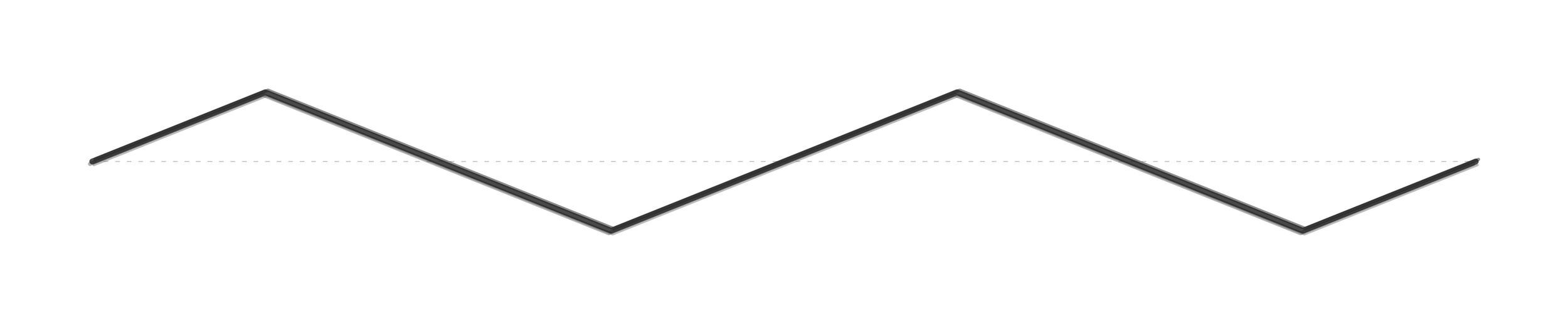
Root perception: integration (+) The releasing articulation of structured systemic complexity as unified pattern.
Geometry: symmetric linear rises and falls, climbing and descending at equal and opposite slopes, meeting at angular points.
Traits: balanced, integrated, symmetric, patterned, structural, geometric, crystalline, harmonic, holistic, systemic, gestalt, multi-perspectival, holographic, fractal, nested, woven, articulated, comprehensive, the both/and, the all-at-once, "I see how it fits."
Temporal: rise-and-fall in equal measure, climb-and-descent, balanced cadence, the symmetrical phrase, the question-and-answer, point-counterpoint, dialectic, the resolution-after-tension, integration as moment, the gestalt-shift, the seeing of pattern, the click of fit.
Spatial: triangle, prism, pyramid, mountain, tent, kite, arrow-and-counter-arrow, the hourglass, the diamond, the lattice-node where multiple lines meet, the tripod, the keystone, the gable, the convergence, the apex, the meeting-point, the crystalline, the snowflake, the woven pattern, the mandala, the nesting fractal.
Gross: integrating multiple concrete factors, embodied skills and practices.
Subtle: integration across perspectives and systems, holding complexity as unified pattern.
Causal: integration as bare capacity of awareness, "I perceive," integrative perception as pure capacity.
Psychophysical Analysis
gentle structuring, holding pattern, mild engagement
The triangle wave sits between the sine and the square. It contains only odd harmonics, like the square, but with much faster amplitude rolloff (1/n² rather than 1/n), which means its spectrum is sparser and its tone gentler. Acoustically, the triangle is heard as flute-adjacent — softer than square, more present than sine. The nervous-system response is correspondingly intermediate: enough harmonic content to engage attention, not enough to drive arousal; enough structure to feel like form is being apprehended, but smooth enough not to alert. Triangle-wave-rich sound tends to produce sustained mild engagement — the cognitive state of attending to pattern without urgency. In contemplative terms it correlates with what's sometimes called open awareness or panoramic attention — alert but not narrowed, structured but not effortful. The wave's symmetric rise and fall produces a felt sense of balance and reciprocity, of climb-and-descent in equal measure, which the body reads as integrative rather than driving. The nervous system, given triangle waves, neither alerts (square) nor entrains downward (sine) nor charges forward (sawtooth) but patterns — finds the shape, holds it, sees how it fits. It is the somatic signature of integration: gentle activation at the service of seeing structure.
VI. The Torus
The torus is a depiction of the model in dynamic representation. The major loop circulates through the temporal phases (arising, sustaining, dissolving). The minor loop circulates through the spatial dimensions (gross, subtle, causal). The four roots of attention appear as the four nodes. The central axis (0-witness) and outer ring (limit-infinity) represent the ever-present Ground of Being. The toroidal flow of polarity spiraling both inward to deep sleep and outward to waking, with subtle as the intermediary between the two.
The 3 configurations correspond to the three states of consciousness — fully extended in waking (ring form), partially gathered in dreaming (intermediate form), gathered closely toward the axis in deep sleep (horn form).
The Number Line Revisited
The toroidal form shows the metaphysical implications of the contrast between the traditional number line even more clearly.
VII. The Matrix
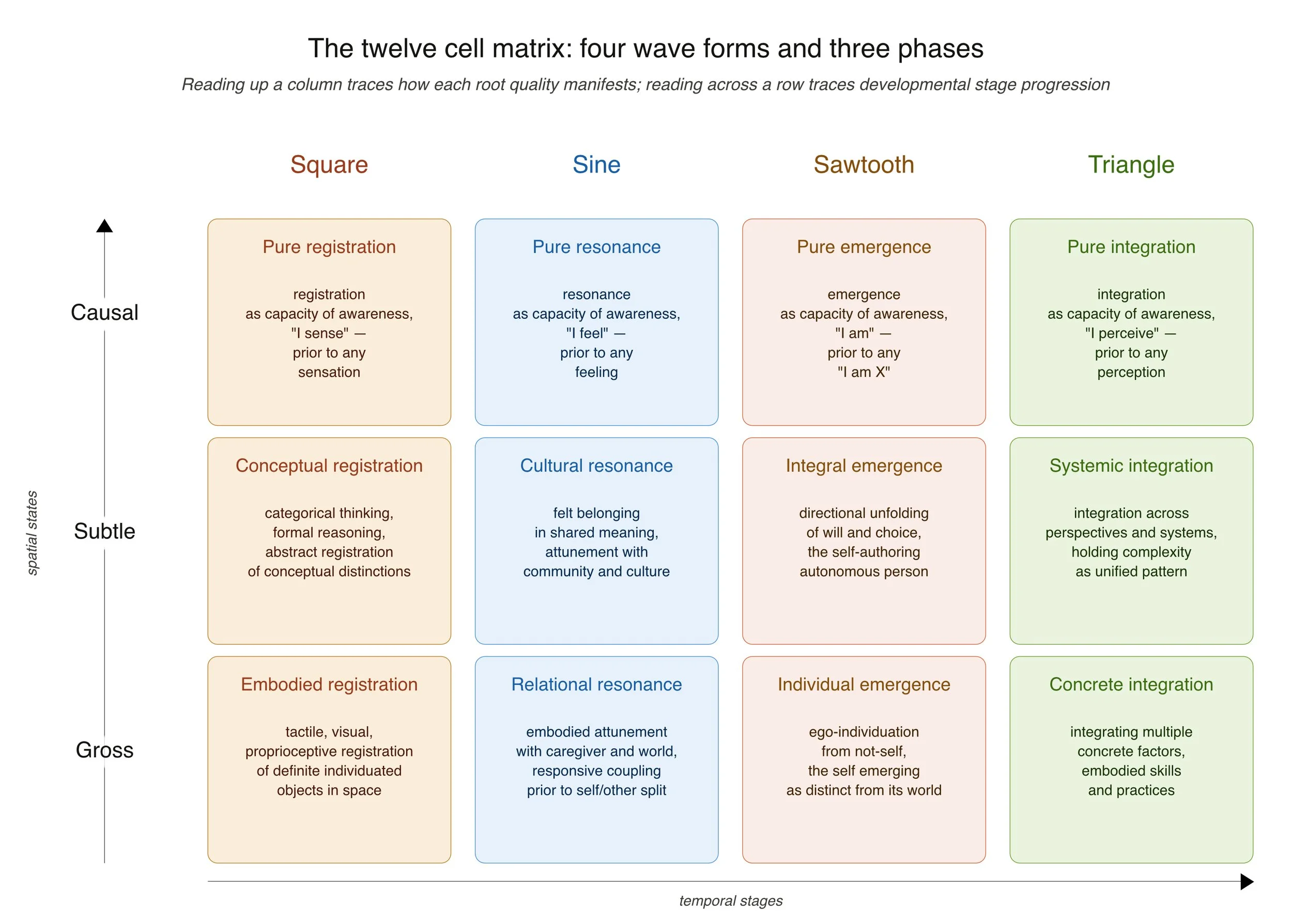
The four roots/wave forms as encountered in three states, depicted as a developmental matrix.
The matrix is always structurally present as potential; mature development allows for the capacity to both witness and inhabit any cell consciously and intentionally in any given moment.
Although development progresses from left to right, from one cell to another from the gross to the subtle to the causal, the living flow of attention (arising, sustaining, dissolving) does not follow any linear arc within the matrix. An experience could move through multiple levels and wave forms simultaneously. The more evolved the individual, the more fluid and dynamic one’s perspective taking and inhabiting becomes.
VII. The Two Roots of Practice
The framework's contemplative work rests on two principles that operate together:
Witnessing capacity. The progressive refinement of awareness to recognize the distinctions of the matrix, so awareness dislodges itself from fixed identification with any specific cell or configuration, or mistakenly embeds the root perception within the phenomena perceived in any given moment. A capacity is developed where there is pure recognition that arises when awareness fully participates in its own modes of manifestation across the matrix, without becoming fixated or identified with any phenomenon appearing within the matrix.
Toroidal flow. The natural completion of cycles of attention, with energy and attention circulating freely across all states, phases and wave form cycles. Mature practice cultivates the capacity for energy and attention to flow through the full toroidal form rather than being fixated at specific cells or unable to access the entire spectrum of the matrix in its temporal and developmental cycles.