

II: Ritual - Invoking Magic
How to craft and present a specially curated musical ritual.
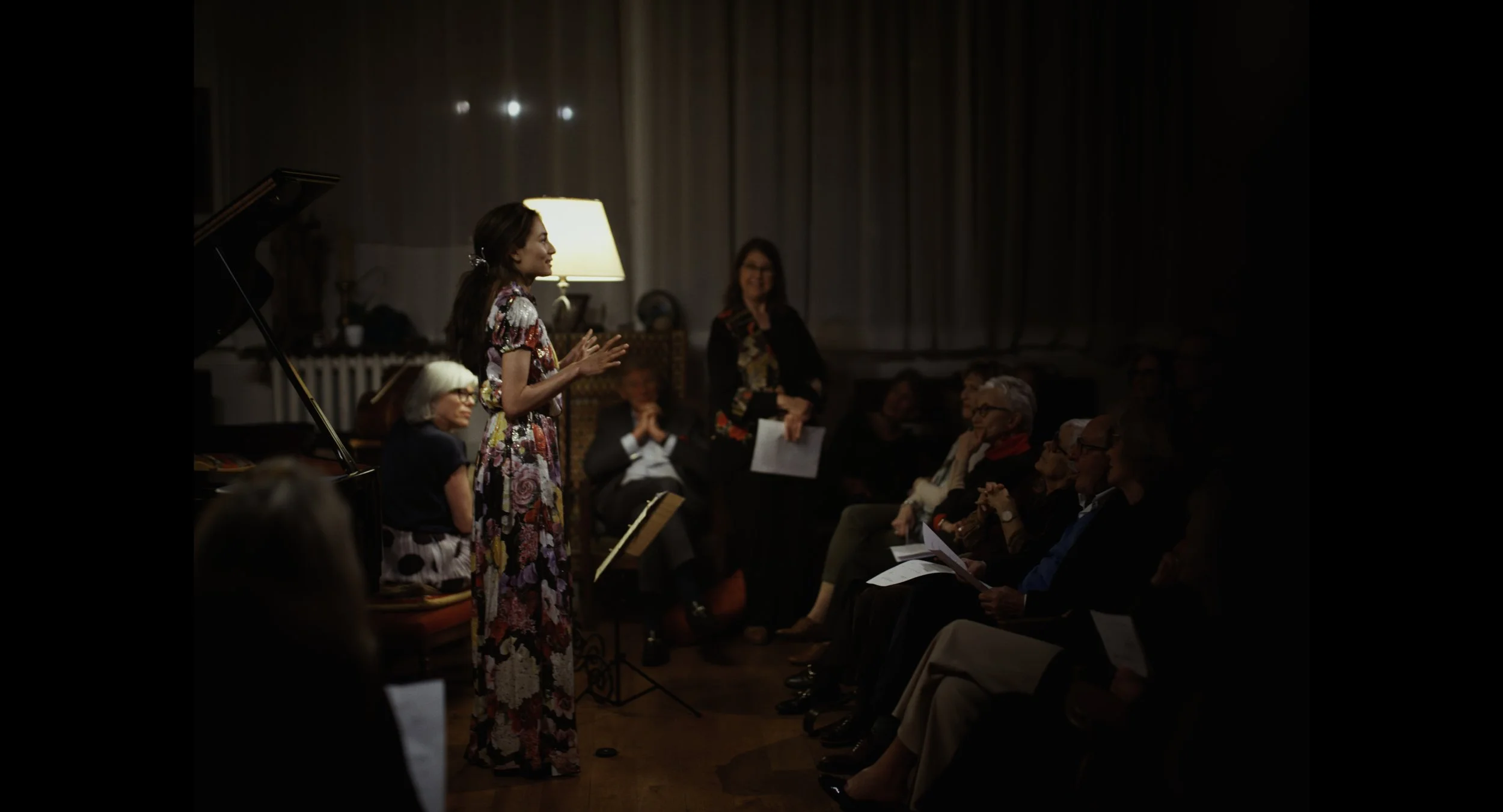
Pianist Audrey Vardanega speaking at a salon in Paris
Masterclass: The Story Triangle
Subverting Tradition to Captivate the Modern Mind
I. Introduction: The Story Triangle
The foundation of any impactful performance rests on three interconnected points. Understanding these allows the performer to move beyond "playing notes" and toward "creating an experience."
The Storyteller: The musician as a magician—the guide of the evening.
The Story: The narrative arc of the program itself.
The Audience: How they receive, integrate, and are ultimately changed by the performance.
II. Intelligent Program Making
In an era of fragmented attention spans and TikTok-length content, the "two-hour warhorse" slog is often a barrier to entry.
The "Leave Them Wanting More" Rule: Avoid saturation and "fidgety" audiences.
The Ideal Structure:
Set 1: 25–30 minutes.
Intermission: 30 minutes (Essential for "human integration" and catching one’s breath).
Set 2: 25–30 minutes.
Integration over Information: Programming should be intelligible to the modern mind, seeking meaning and continuity over sheer volume.
III. The Art of the Storyteller (Verbal Mastery)
Your words are powerful allies, but they must be used with precision.
The Trap of Technicality: Avoid the "music theory lecture." If a five-year-old can’t feel what you’re saying, it’s too complex.
Language of the Elements: Replace obscure terms with:
Colors: Brightness vs. Darkness.
Emotions: Sadness, struggle, and joy.
Metaphor: Lean into the collective human journey rather than the "arcana" of history.
The Primary Mission: Remember that the audience is there to listen to the music first. Use words only to "contextualize the unfolding."
IV. The Performer as Curator
Why choose these four pieces out of all human history? A great program is a coherent statement, not just a list of songs.
Linkage Points: Identify the contact points between pieces. What do they tell us about who we are?
Frameworks for Selection:
The Threefold Conception: From Initiation to Conflict to Resolution.
The Fourfold Conception: Elemental energies (Fire, Air, Earth, Water).
The Simple Polarity: The interplay between Light and Dark.
V. Live Performance Presence
How to manage yourself while you are "up there" sharing with the crowd.
The Sensitivity Practice: Constantly check in with your internal state.
Managing Tempo: If you feel like you are speaking too much or too fast—you probably are.
The Power of the Pause: Take a second. Take a breath. Own the moment; it belongs to you.
"Take out any theoretical musical expressions; center metaphor and our collective human experience."
-
Add a short summary or a list of helpful resources here.